The Gospel according to Dr. Seuss

The New Testament contains four gospels that tell the story of Jesus’ life. In Greek, gospel literally means good news. Matthew, Mark, Luke, and John are evangelists who proclaim the saving grace of Jesus Christ. Their entire goal is to invite their readers to accept Jesus as Savior and Lord.

Over the centuries, others have retold the gospel story in a rich variety of ways. Jesus’ life has been portrayed through paintings, sculptures, frescoes, stained glass, operas, musicals, theological books, novels, and even animated cartoons. Although the medium might change, the message remains eternal.

In our post-modern world, Christian authors continue to seek fresh new ways to tell the old, old story of Jesus and his love. Contemporary books include The Gospel according to Peanuts, The Gospel according to J. R. R. Tolkien, The Gospel according to Harry Potter, and even The Gospel according to the Simpsons!

Gospel according to Dr SeussIn 2004, James W. Kemp published The Gospel according to Dr. Seuss. At the time, the Reverend Kemp was a retired United Methodist minister living in Kentucky. In the Introduction, the pastor wrote:

Dr. Seuss remains my favorite theologian. When I was a pastor, I found that I could find no better illustrations for biblical principles than I found in Dr. Seuss’s stories. His themes help us to understand what is truly important in life. His messages cause us to think about ourselves in new ways.

Dr. Seuss was born as Theodor Seuss Geisel on March 2, 1904 in Springfield, Massachusetts. He graduated from Dartmouth College and pursued a career in advertising. In his late twenties, Geisel had time on his hands. His contract with Standard Oil prevented him from working on other ad campaigns. However, it did not prohibit writing children’s books.

So in 1938 he published And to Think that I Saw it on Mulberry Street. He used his middle name as a pseudonym because he planned to write “serious” books under his real name. He added the title of “Doctor” because his father had always hoped he would be a physician!

Geisel went on to write over fifty children’s books under the names of Dr. Seuss, Theo LeSeig, and Rosetta Stone. During his career, he received three Oscars, two Emmys, and one Pulitzer Prize. He died in California at 86 years of age in 1991.

In 1957, Geisel published a book featuring a fantastical creature who became the symbol of all things Seussian. In an era of Dick and Jane school books, a publisher at Random House Books challenged Ted Geisel to write something new. Using 223 words from the basic Dolch Reading List, Geisel created a whimsical tale about a cat in a floppy top hat. The Cat in the Hat sparked a revolution in beginning readers’ books.

The author of The Gospel according to Dr. Seuss, James Kemp, wrote that the Cat in the Hat was one of his favorite characters. In an interview, he said: Through him we see that something good can come out of bad circumstances; we are never hopeless.

Kemp’s statement is all the more remarkable when you know his life story. After fifteen years as a United Methodist minister, James was forced to take early retirement due to severe multiple sclerosis. In his mid-forties, he became a quadriplegic. He dictated his writing to his mother, and his wife handled interviews.

Reverend Kemp died in 2006 after battling MS for 20 years. Just before his death, he told his family that he wanted them to “put the fun back into funeral” for his memorial service.

This is the same man who said with absolute conviction: There is always hope in the unlimited richness of God. Most of our problems are trivial. What a lived out affirmation of faith that witnessed to how a Christian lives  . . . and dies.

Indeed, there is always hope in God’s grace and love. No matter how big a mess we have made of life, our Lord can clean us up and forgive us for the past. He provides order in the midst of chaos and purpose in the face of meaninglessness. Then Christ restores us to right relationship with self, others, and God.

It is not Seussian rhyme, but another poet put it this way:

Amazing grace, how sweet the sound, that saved a wretch like me,

I once was lost but now am found, was blind but now I see.

Cheeseburger is Paradise

I recently visited a local restaurant that specializes in hamburgers. I pretended to peruse the menu for healthy alternatives like salmon or salad, but my taste buds already knew how THAT internal debate would end.

CheeseburgerAfter delivering water and bread, the waitress asked for my order. Without hesitation, I ordered a medium burger with the works—topped with American cheese, sautéed mushrooms, and grilled bacon. A side of crisp fries completed the gourmand repast.

Twenty minutes later my heart-attack-on-a-plate arrived. I poured ketchup on the meat and fries before slathering the bun with mayonnaise and mustard. I gripped the burger with two hands and anticipated the first bite with carnivoristic delight.

My Food Conscience picked that inopportune moment to make an appearance. The imaginary figure—nicknamed “Mac” in my mind—plays the role of Jiminy Cricket to my Pinocchio, reminding me of dietary rights and wrongs. For older readers, Mac looks like a pint-sized Jack LaLanne in his peak years before he started hawking juicers.

Grease dripped down my fingers as I brought the burger to my lips. “Ahem,” Mac interrupted. “Are you REALLY planning on eating a MEDIUM cooked hamburger? You remember all those articles about Mad Cow Disease, don’t you?”

I attempted to ignore his words while staring at the pink hamburger. “And another thing,” my Food Conscience continued. “You’re about to eat half a pound of red meat. Just how long do you suppose it will reside in your digestive tract?”

“To make matters worse, you ordered a Cheeseburger. You KNOW that you’re lactose intolerant. The processed cheese will keep us both up all night.”

“And don’t even get me started on the three strips of bacon that came with the order. Meat-on-meat—what WILL they think of next? Do I need to remind you of your cholesterol numbers? You’re north of 200, big boy, and just courting an all-expense-paid-trip to the Coronary Intensive Care Unit.”

He didn’t stop there. “I couldn’t help but notice the hamburger bun. White bread? What happened to your New Year’s resolution about multigrain?”

I quickly changed the topic, pointing out that the meal came with healthy toppings like lettuce, tomatoes, and mushrooms. Lettuce certainly counted as a vegetable, but I’ve never been quite sure about tomatoes . . . fruit . . . vegetable . . . who knows? Mushrooms actually come from the fungus family, but I figured the FDA might include them somewhere among the vegetable family.

Mac snorted in disgust. “Great choices, friend. Did you know that salmonella bacteria are found more on leafy vegetables than in ground meat? No telling where that slab of Iceberg lettuce has been.”

“Tomatoes are dandy—and they are considered to be a fruit and not a vegetable, genius! However, the ketchup covering your plate is actually red-colored sugar.”

“Don’t try to kid me about the mushrooms. The cook barely wiped the dirt off those fungi before sautéing the toadstools in a pound of butter.”

I pushed the mushrooms to the side of the plate and picked up a handful of fries. “Hellllooo!” Mac called. “Ever hear of high blood pressure? Those fries have enough grease and salt to dry up your blood. Dredge them through the ketchup, and you have the perfect combination of mega salt and sugar.”

I pointed out that I had self-righteously ordered a diet drink rather than carbonated candy. My Food Conscience shook his head in disgust. “Here’s a rule of thumb,” he announced. “Never eat or drink anything that you cannot pronounce or grow. Can you say ‘aspartame?’ When was the last time you picked some good old potassium benzoate off a tree?”

I sighed, wondering why the good Lord created bad food that tasted so great. In mid-reverie, I absentmindedly took a sip of water while Mac asked, “And did you see the latest reports on water quality?”

Enough was enough—I banished my Food Conscience back to wherever he lived when I was a teenager and could eat whatever I pleased. Alone again, I cleaned my plate without guilt or remorse. When no one looked, I sopped up the greasy remains with some white bread.

I sat back in sated bliss, convinced that I could not eat another bite. Then the waitress walked over and asked, “Did you save room for something sweet?”

After a moment’s hesitation, I decided it would be rude if I didn’t at least glance at the dessert menu.

Yogi-isms

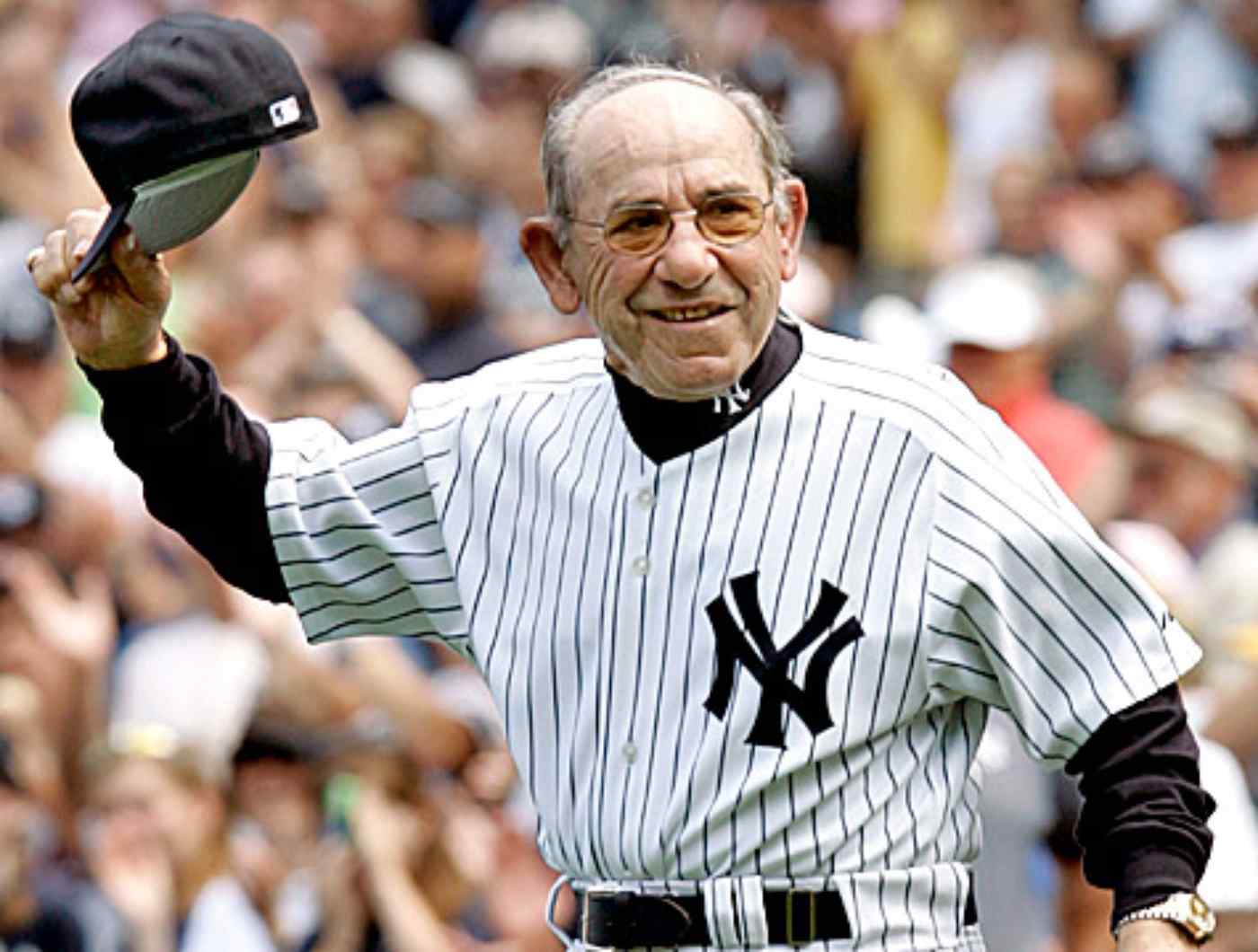
Yogi BerraLast week Major League Baseball lost a legend when Yogi Berra died at 90 years of age. Ranked among baseball’s greatest players, many fans contend he was the game’s best all-around catcher.

Born in 1925 in Saint Louis, his parents named him Lawrence Peter Berra. Yogi later gained his famous nickname from a friend who claimed he resembled a Hindu shaman (a yogi). His entry into the Baseball Hall of Fame in 1972 honored an exceptional career as a player and coach.

Following his naval military duty during World War II, the New York Yankees signed Berra in 1947. He eventually wore the famous pinstripes for nineteen years on the field and in the dugout. During his career, the Yankees appeared in fourteen World Series and won the title ten times. Berra played in fifteen All-Star games and won the league’s Most Valuable Player Award three times.

After retiring as a player, Yogi first coached the Yankees’ cross-town rivals, the New York Mets. Then he returned to coach and later manage his beloved Yankees from 1976 to 1985. He finished his career as a coach with the Houston Astros in 1992.

Berra dropped out of school in eighth grade and became infamous for murdering the Queen’s English. He possessed an uncanny knack for bending language pretzel-like into unrecognizable shapes. He has been widely quoted over the years, and “Yogi-isms” have become part of our culture. Some of his more famous adages include:

“It ain’t over till it’s over.” The original setting for the quote occurred during the 1973 National League race when the manager said: “You’re never out of it ‘til you’re out of it.” Berra has become so identified with this statement that he claims his tombstone epithet will read: “It’s over!”

“It’s like déjà vu all over again.” Although Yogi wasn’t known for his foreign language skills, he confirmed that he uttered these words after watching back-to-back homeruns by Mickey Mantle and Roger Maris.

“We made too many wrong mistakes.” This insightful observation came after the Yankees lost the World Series in 1960. Wrong mistakes must be much worse than right ones.

Other delightful Yogi-isms include:

  • “A nickel ain’t worth a dime anymore.”
  • “Always go to other people’s funerals; otherwise they won’t come to yours.”
  • “Half the lies they tell about me aren’t true.”
  • “If you come to a fork in the road, take it.”
  • “It gets late early out there.”
  • “Nobody goes there anymore. It’s too crowded.”
  • “The hotel towels were so thick that I could hardly close my suitcase.”
  • “You better cut the pizza in four pieces because I’m not hungry enough to eat six.”
  • “You can observe a lot by just watching.”
  • “You’ve got to be careful because if you don’t know where you’re going you might not get there.”

Like Mark Twain, no doubt Berra has been credited for many things that he never said. When he tried to set the record straight, however, Yogi couldn’t resist yet another Yogi-ism. He protested straight-faced: “I never said half the things I said!”

It ain’t over till it’s over; and for God’s people, it ain’t never over. Thanks for the memories, Yogi.

Because a Little Bug Went Ka-Choo!

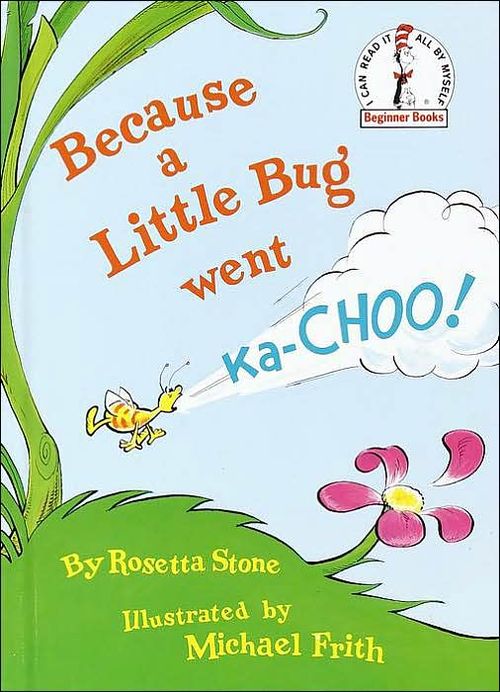
Because a Little BugI recently preached a sermon series entitled The Gospel According to Dr. Seuss. We explored five children’s stories by the popular author. Because a Little Bug Went Ka-Choo! ranks among my favorite books by Theodor Geisel. Although Geisel normally used the pseudonym of Dr. Seuss, he published the 1975 book under the name of Rosetta Stone.

Because a Little Bug Went Ka-Choo! teaches what appears to be a simple lesson that even preschool children can understand: actions always have consequences.

A fundamental law of creation is the principle of cause and effect. If I do THIS, then THAT will happen. If you select THIS button on the vending machine, then THAT will come out. 1 + 2 = 3.  A + B = C.

It’s the domino principle of life. Push one domino and others begin to fall. One thing leads to another and another and another . . . oftentimes with unforeseen results.

In a world governed by the law of cause and effect, here is an important corollary principle: inconsequential actions do not exist. All we do affects ourselves and others. The person that mutters, “Well, I’m hurting only myself,” has not discovered this basic truth. Everything and everyone are interrelated. Seemingly small events can have huge consequences.

A prime tenet of Chaos Theory is The Butterfly Effect. In a chaotic system, a very small change applied at a particular point in time makes the future change in dramatic ways. Something as small as a butterfly flapping its wings might affect the weather system on a global scale six months into the future.

The Butterfly Effect may sound like hyperbole, but words and actions act like stones thrown into a still pond. The expanding ripples spread in unexpected ways to influence other people’s lives. We cannot always anticipate the results.

Cause and effect. The dominos fall. No inconsequential words and deeds. All that we say and do affects our lives along with others.

These are important principles for followers of Jesus Christ to understand. God does not call most of us to become missionaries or martyrs. Few will have the opportunity to serve God in blazing moments of glory. For the most part, Christian discipleship is acted out in the ordinary and everyday moments of life. However, these small acts of discipleship can have unimaginable consequences.

Fred Craddock was one of my mentors in seminary who taught preaching at Candler School of Theology. He once said: “We think giving our all to the Lord is like taking a thousand dollar bill and laying it on the altar: ‘Here’s my life, Lord, I’m giving it all.’ But the reality for most of us is God sends us to the bank and has us cash in that thousand dollars for quarters. We go through life putting 25 cents here and 50 cents there. To be kind to the neighborhood kid rather than say, ‘Get lost.’ To go to a committee meeting or serve your church when needed. To give a cup a water to a shaky old man at a nursing home.”

Usually giving our life to Christ is not glorious. It’s done in all of these little acts of love, 25 cents at a time. It would be much easier to put it all on the line at one time, we would know the outcome, that we have accomplished what we have been asked to do, but that’s not what God wants.”

Holiness is practiced in the humdrum of routine; but these “ordinary” moments can have an extraordinary effect. Our words and actions are powerful. What we say and do each day ripples through time and eternity. Cause and effect. Action and reaction. Truth and consequences.

All because a little bug went KA-CHOO. God bless you!

Get Real

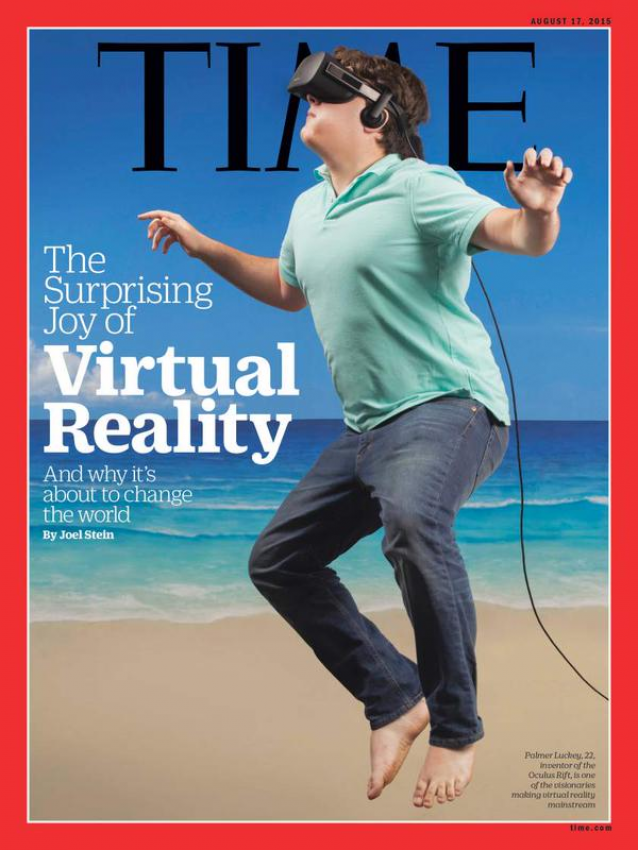
Time August 2015On August 17th, the Time magazine cover featured Palmer Luckey. The twenty-two year old invented the Oculus Rift, a virtual realty headset. Last year Luckey sold his startup company to FaceBook for $2.3 billion—yes, BILLION with a capital “B!”

The cover article discussed the emerging field of virtual reality. Headsets transport users into a computer generated landscape. Although still in the development stage, science fiction promise is becoming science fact.

Work also continues on augmented reality—the updated term for holograms. Experts foresee a day when glasses will be able to project realistic holograms on the real world.

First adopters of virtual and augmented reality have even coined a term for the world around us. They call it REAL reality! However, a reader gets the sense that most prefer their alternate realities to the real world.

But is  even the real world really REAL? Much of what we consider real is no more substantive that a computer generated world. Albert Einstein said: Reality is merely an illusion, albeit a very persistent one.

Jesus told The Parable of the Rich Fool (Luke 12) where a man enjoys a great harvest, builds bigger barns, and plans to enjoy a wealthy retirement. In the darkness of the night, however, he dies—and all his riches go to someone else.

Christ defines what is real with a simple, diagnostic question: Will it last? Is it eternal or temporal?  Storing up the things the world calls real will result in disappointment. Only treasures stored up in heaven’s vaults will last. True reality is not the physical but the spiritual, not the temporal but the eternal.

After all, what good is it to gain the whole world and lose your soul? (Matthew 16:26)

In his classic book, The Great Divorce, C. S. Lewis describes a man’s visit to heaven. Lewis presents a strange but mesmerizing image of the afterlife. God’s kingdom is so real that the grass will not even bend under the feet of those newly arrived. Streams of water are as solid as moving roads. And those who first enter seem as ephemeral and transparent as ghosts. As persons travel up into the “high lands” towards God, however, they become more and more solid.

Lewis summed up the theme of the book when he wrote: Heaven is reality itself.  All that is fully real is Heavenly. (p. 69)

The real world is NOT:  paychecks . . . traffic jams . . . stocks and bonds . . . insurance policies . . . social status . . . school awards . . . recognition by our peers . . . latest fashions . . . our favorite TV program . . . politics . . . bank accounts . . . trophies . . .

The real world IS:  reading a book with our child . . . holding hands with your spouse  . . . talking with a friend . . . studying Scripture . . . worship . . . prayer . . . sharing with someone else about Christ . . . feeding the hungry, giving drink to the thirsty, housing the stranger, clothing the naked, and visiting those who are sick or in jail . . .

In summary, reality is the spiritual part of life, the part of life that is invested in eternity.  Any part of life that is exclusively related to this world is not reality, but only a passing moment, necessary for the time, but certainly not ultimate.  What is really real connects us to the eternal while we live in the temporal, links us to God’s kingdom while we continue on in the world.

So . . . get real.

Labor Day Weekend

Have you ever noticed how calendar time and real time are two different types of time? Confused? Consider this timely example.

In school, children learn the four seasons of spring, summer, fall, and winter. Astronomers calculate the start and finish of each season based upon the sun’s solstice and equinox.

According to calendar time, summer begins on June 21 and ends September 21. In real time, however, summer starts on Memorial Day weekend and concludes on Labor Day weekend. This weekend marks the real end of summer and beginning of fall, regardless of what the calendar might say.

Labor DayLabor Day is observed on the first Monday in September. Since September 1 fell on a Tuesday this year, the holiday weekend arrives as late as possible.

New York City hosted the first Labor Day in 1882. A machinist and a carpenter organized a parade to recognize workers. The holiday quickly became a national observance.

Few people consider Labor Day to be a particularly Christian holiday. The church gladly claims Thanksgiving, Christmas, and Easter; but the first weekend in September has never been considered a particularly religious observance.

However, Labor Day reveals an important truth for God’s people. We are all guilty of grumbling and griping about our daily responsibilities. We often view work as a necessary evil; and we envision paradise as an endless vacation. We forget that work is a good thing created by the Lord for his people.

Reread the creation account in Genesis 1-2. The Lord did not place Adam and Eve in the Garden of Eden to enjoy a life of ease. Instead, God created them for a life of productive and fruitful labor. They cared for the Lord’s creation, worked as gardeners in Eden, and served as stewards of this wonderful world.

Work gives meaning and purpose to life. Fulfillment comes from using our God given abilities and resources in ways that are pleasing to the Lord. Labor Day weekend is an excellent time to reflect upon the jobs God has given us in heaven’s kingdom.

“Vocation” is a rich word filled with meaning that the church abandoned in recent years. Today it is a synonym for a job or profession. In the original sense, however, a vocation meant a commitment to the religious life. The word comes from the Latin root “to summons” or “to call.”

Call is an important part of our understanding of the Christian experience. All of God’s children have responded to Christ’s common call.  Each in his or her way has heard Jesus say: Come, and follow me.

Along with our common call we each receive a variety of callings. In 1 Corinthians 12:4-11, Paul wrote:  There are many different kinds of gifts, but the same Spirit. There are different kinds of service, but the same Lord. There are different kinds of working, but the same God works all of them in all men. Now to each one the manifestation of the Spirit is given for the common good.

God created us as unique individuals, suited and equipped for different work. God’s people share a common call with a variety of callings. During the upcoming Labor Day weekend, give thanks to the Lord for the opportunity to work.

Vocation is more than making a living, it is creating a life.

The Marshmallow Test

marshmallow testIn 1972, a group of Stanford University psychologists conducted an experiment on delayed gratification using . . . marshmallows! Children sat at a table with one marshmallow in front of them. They could eat the treat immediately; but if they waited, then they got a SECOND marshmallow.

Would you have possessed the discipline as a child to wait patiently? A longitudinal study of the original group discovered that the children who waited for the second marshmallow made better grades in school. In high school, they also earned higher scores on their SATs.

Here’s a harsh truth that we like to ignore: life is difficult, and it is filled with difficult decisions. People try to ignore this fundamental fact, hoping it will go away. However, it does not change the basic truth: life is difficult, and it is filled with difficult choices. (Read The Road Less Traveled by M. Scott Peck)

Jim Rohn is a successful businessman and motivational speaker. He observes: We must all suffer from one of two pains: the pain of discipline or the pain of regret. The difference is discipline weighs ounces while regret weighs tons.

Rohn’s words contain both bad news and good news. The bad news is there’s going to be PAIN regardless of our choice—life IS difficult. The good news is we choose what type of pain to experience: the momentary pain of discipline or the lasting pain of regret.

Discipline endures momentary pain for long-term gain. Regret purchases short-term gain at the cost of long-term pain. Eat one marshmallow now or wait for a second one later.

We KNOW what’s better for us. So why don’t people always choose the pain of discipline rather than the pain of regret? Two reasons occur to me:

  • The pain of discipline hurts NOW—and we are a short-sighted people
  • Instant gratification is a powerful incentive

I’ve become more and more convinced that delayed gratification is a fundamental spiritual principle of the Christian life. God created us a people of passions. Our passions and desires are good gifts from a loving Lord. However, we spend a lifetime determining whether we will control our appetites or our appetites will control us.

Our desires make wonderful servants but terrible masters.

The principle of delayed gratification—saying “No” in the short-term for a greater “Yes” in the long-term—applies to every aspect of life: school, work, responsibilities, chores, finances, sexuality, diet, exercise, addictive behavior, and more.

In a fallen world, the bad news is every choice involves pain. The good news is that we choose which type of pain to experience: the pain of discipline or the pain of regret. Discipline weighs ounces and regret tons.

Wait for the second marshmallow!

For those wanting to read more about delayed gratification and procrastination, I recommend a book by Brian Tracy entitled Eat that Frog. Its available at amazon.com for only $8.74.

Bill Burch’s Top 20 Movie List of All Time (Part 2)

(During last week’s blog, I listed my favorite movies from 20-11. This week I complete the list with the Top 10. Here we go movie fans!)

the movies10. Father of the Bride. I’m talking about the remake of the classic movie starring Steve Martin and Diane Keaton. The women in my life absolutely LOVE this film, and we’ve literally watched it dozens of times. The sequel (named Father of the Bride 2!) is just as good. I cannot even begin to describe Martin Short’s performance as Franck.

9. Jaws. Steven Spielberg’s classic kept my generation out of the water and on the beach. After seeing the huge shark, Chief Brody delivers one of the greatest lines of all time: “You’re gonna need a bigger boat.”

8. Tootsie. Dustin Hoffman the actor plays an actor who plays an actress for the work. Bill Murray (who appears several times in my Top 20 list) steals several scenes.

7. E. T. Spielberg once again evokes marvel and magic in the hearts of children of all ages. Many have also noted the plot’s parallels to the Gospel story. The main character descends from heaven, performs miracles, heals the sick, dies, miraculously comes back to life, and then ascends into heaven. Sound familiar?

6. Ghostbusters. Any movie that combines the comedic genius of Bill Murray, Dan Aykroyd, Harold Ramis, Rick Moranis, and the Stay-Puff-Marshmallow-Man has got to be good. The sequel . . . not so much. “Who ya’ gonna call? GHOSTBUSTERS!”

5. Alien(s). Terror and sci-fi combine in the original Alien starring Signourney Weaver as a take-no-prisoners heroine. The critter in the movie would devour E. T. in a Martian minute. In a rare occurrence, the sequel (creatively named Aliens) is even better than the original. However, I strongly advise against the rest of the series.

4. Harry Potter and . . . . Pick a movie out of the franchise. So sue me—I’m secure enough in my manhood to admit that I like the Harry Potter novels and movies. My favorite remains the first film that magically portrays Hogwarts School in all its glory.

3. Indiana Jones and . . . . Harrison Ford redefined the action hero genre with his brimmed hat and cracking whip. Movies 1 and 3 in the series rank high—movies 2 and 4 do not deserve the proud name of Indiana Jones.

2. Lord of the Rings and The Hobbit. This is a twofer—actually a sixfer since it combines two trilogies. Yes, I am a confirmed nerd—I’ve read Tolkien’s trilogy along with The Hobbit multiple times (I am embarrassed to publish the exact number). Peter Jackson surpassed all of my expectations with the film versions of the books.

1. Star Wars. I’m talking about the FIRST Star Wars movie back in 1977 before George Lucas started tinkering with the titles and numbers, before CG took over special effects, and before Lucas abandoned any semblance of a plot. Four decades (almost 40 years?!?! OHMYGOSH) later the special effects look dated, but who wouldn’t want a cool light saber and X-Wing fighter?

When it comes to movies, I favor pure escapism. I get enough of real life in my profession. I love comedy, adventure, science fiction, and fantasy. If Bill Murray ever costars with Harrison Ford in a sci-fi adventure set in Middle Earth, then I’ll be the first in line.

Otherwise, I prefer reading a good book. Most of the stuff out of Hollywood is not worth the price of admission.

Bill Burch’s Top 20 Movie List of All Time (Part 1)

Periodically, an individual or organization publishes a Greatest Movies’ list. A cursory search on Google uncovered a variety of such attempts.

moviesAt random, I chose the Top 100 Greatest Movies by the American Film Institute. The organization chose 400 films based upon “historical significance, critical recognition and awards, and popularity determined by box-office revenue, syndication, video sale and rental figures.” Then over 1,500 members of the institute voted on the top 100.

After reviewing the list, I made the surprising discovery that I had seen 41 of the 100 movies listed by the American Film Institution. (OK, 40 and 1/2 —I closed my eyes during the scariest parts of The Sixth Sense!)

As a public service, I am publishing Bill Burch’s Top Twenty Movie List of All Time . . . well, at least for the past century.

20. The Matrix. The sci-fi notion that humans live in virtual, computer-generated reality blew my mind. Consider it a modern retake of the classic children’s book, The Velveteen Rabbit, which poses the question: “What’s real?” Well, except for special effects, high-tech weaponry, and software viruses that will kill you. This franchise would have done well to stop with the original.

19.Toy Story. Pixar’s first feature length film redefined animated movies. I saw the movie in the theater with my daughter who was five years old, and the experience felt magical. Buzz Light Year discovers love and friendship truly define life.

18. The Princess Bride. OK, the fantasy story doesn’t qualify as a manly-man’s sorta movie. I still rest secure in my machismo. The fairy tale cum children’s book features priceless scenes and quotes. The sword duel. Rodents of unusual size. “As you wish.” “Inconceivable!”

17. Forrest Gump. Tom Hanks portrays a simple man whose life shapes the major events of his day. Life really IS like a box of chocolates.

16. Saving Private Ryan. Tom Hanks makes a second appearance in my list as an officer leading a platoon during World War II. I watched transfixed when the movie abruptly shifted from black and white to color during the Normandy D-Day invasion. The scene vividly portrayed the sacrifices of those who fight to protect our freedoms.

15. Die Hard. I hesitated to include the first in the Bruce Willis film franchise due to the language of the uncut version. However, the film redefined the action movie . . . and I’ve never heard Beethoven’s Hymn to Joy in quite the same way again.

14. Caddy Shack. It’s a risqué movie one wouldn’t want to watch with school age children. However, Bill Murray as Carl the Groundskeeper steals the show. I’m laughing as I type this blog, recalling the scene where Carl fantasizes about playing in The Masters while lopping off the tops of flowers. “I got that going for me, which is nice!”

13. American Graffiti. The 1973 film featured a galaxy of future stars, including Ron Howard, Richard Dreyfuss, Harrison Ford, Mackenzie Phillips, Cindy Williams, and, of course, Wolfman Jack. The movie captures the wonder and angst of adolescence.

12. Young Frankenstein. I’m not a huge Mel Brooks fan—his humor usually exceeds even my admittedly high silliness quotient. However, Gene Wilder shines with pure genius as Dr. Frankenstein’s grandson. “Werewolf? THERE wolf.” “Put the candle BACK.” “Frau Blucher!”

11. The Terminator. Arnold Schwarzenegger stars as a time-traveling robot from the future—need I say more? I must admit the sci-fi flick appears 11th in my list so that I can end this week’s blog with the Arnold’s favorite line: “I’ll be back!”

It’s a Dog’s Life, Part 2

Sam with Bone(Bill decided to take a break from his writing duties. The family’s Yorkshire Terrier, Sam, volunteered to serve as today’s guest columnist. Views expressed by the canine in no way reflect the blogger’s opinions.)

What Bill DIDN’T note in his introduction is that I am a RETURNING guest columnist. My first blog appeared back in February. He also conveniently forgot to mention that my post received the most visits ever on his website.

Jealousy is so unbecoming in a human.

I also don’t get the whole “views expressed by the canine” disclaimer. I see the world from eight inches off the floor—of course our views on things differ. DUH!

We’ve been together for almost eight years now. I adopted the family while still a pup. I surprised them on a Christmas morning when Santa brought me down the chimney. Forget electronics, clothes, or jewelry—the best presents love you back.

I don’t demand much in return—kibble, treats, walks, and tummy rubs keep me happy. Humans could learn something about contentment from their canine companions.

My humans insist on treating me to a spa treatment every six weeks. The cosmetician gives me a wash and cut before spritzing me with cologne. Then she ties a bandana around my neck.

I hate bandanas.

I also despise having my nails done. Despite my vocal protests, the woman insists on clipping my paws. One time she tried to buff my nails with a Dremel grinder. A lift of my lip and a flash of my teeth convinced her otherwise.

In a just cosmos, the Top Dog would send pet groomers to their own special corner of hell. Let’s just see how they like having their glands squeezed for all of eternity!

Until I properly trained them, my family experimented with feeding me only twice daily. Puh-lease! I’ve watched the man of the house—he eats three meals a day and snacks in between. Why should I be treated any different?

Don’t get me wrong—I still tip the scales at a svelte 10.5 pounds. However, I like the security of food in my bowl 24/7/365.

Even if it’s full, I like to scratch the floor beside my bowl. This informs any human within hearing range it’s time for His Highness to dine. I insist the nearest non-canine top off the bowl with fresh food—yet another endearing practice that my humans adore.

Over the years, I’ve accumulated a basket of squeaky toys. I occasionally treat my humans to a tug-of-war game. I’ve been best friends with Moo-Cow for years. I drag her into the middle of the floor and tear out her stuffing before snuggling together. Love hurts sometimes.

The man likes his routine. Every morning we wake up and take a walk around the neighborhood. Then he tops off my food and water bowls. Before leaving the house, he always takes me outside a second time. Then we observe “Trick and Treat” time.

Humans LOVE to do tricks. After he pulls a treat out of the box, I’ve trained him to hold it over my head and say “Sit!” Then I hold out my paw, and he’s learned to shake hands. Dropping on my stomach cues him to say “Down!” Finally, I allow him to give me a treat.

Like I said last time, it’s a dog’s life, and I’m not complaining. The Great Master in the Sky has blessed my family richly. Between you and me, I believe the Hound of Heaven has a soft spot for canines.

Think about it—“dog” is “God” spelled backwards. Coincidence? I don’t think so!